.png)
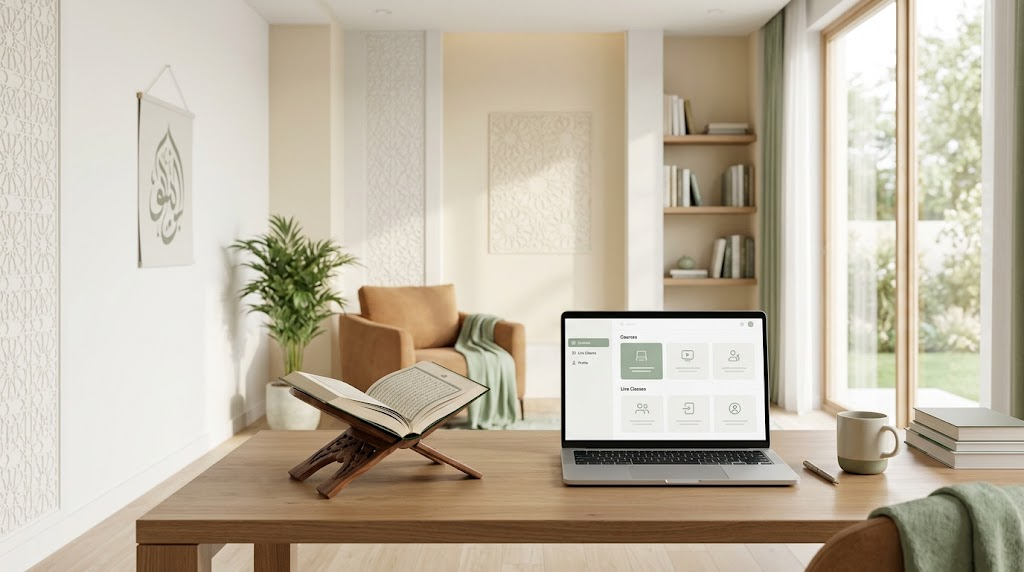
Learn Quran online — your teacher, your time, your pace.
Live one-to-one classes with a qualified teacher, fixed in your timezone, with weekly progress updates — no groups, no shortcuts.
Our mission online
Most Muslim families outside the Muslim world face the same quiet problem: they want their children taught the Quran properly, and the options nearby are a weekend school with forty children per class, or nothing. Our online academy exists for exactly that gap — to put a qualified, supervised, personally known teacher inside any home with an internet connection.
What a class looks like
At the agreed time, the teacher starts the meeting — Zoom or Google Meet, whichever your family prefers. Student and teacher open the same book: Qaida for beginners, mushaf for Nazra and Hifz. The student reads aloud; the teacher listens, stops, corrects, and moves on. For a 30-minute children's class the rhythm is revision first, new lesson second, mixed practice last.
There is no software to learn and nothing special to buy. A phone propped against a stack of books works; a tablet or laptop is better. We help every family with setup during the trial week, and class links arrive on WhatsApp before every lesson.
One-to-one, and why we insist on it
Group Quran classes fail quietly. A student mumbles along, the teacher cannot hear individual errors, and after a year the child has memorised sounds rather than learned to read. Our academy has one non-negotiable rule: every class is one student and one teacher. It costs more to run. It is also the only format in which a teacher can truthfully say they heard every letter the student read this week.
Your teacher, chosen with you
In the trial we match you with a teacher based on the student's age, level, language, and your preference for a male or female teacher. If the fit is wrong — it happens, teaching is human — we rematch without fuss. Once settled, that teacher stays with your family. Some of our teachers have taught the same child from Qaida to Hifz completion.
Flexible scheduling, honestly described
Fixed weekly slots in your timezone, chosen when you enrol. Evenings and weekends fill first — book the trial early in the week if you need those. Missed classes are rescheduled freely with notice; the only thing that forfeits a class is a no-show without word. Ramadan schedules shift each year and we adjust every student's slot with the family.
For students in every timezone
Our teaching day runs long precisely so that after-school in Toronto, after-dinner in London, and morning in Sydney are all normal class times. Current students span the UK, USA, Canada, Australia, the UAE, Saudi Arabia, and Pakistan.
The learning process, end to end
From first message to steady progress — this is the whole journey.
- Step 1
Free trial (3 classes)
The teacher meets the student, assesses their level honestly, and recommends a starting course. No payment details, no commitment.
- Step 2
Enrolment
Choose a plan — 2, 3, or 5 classes weekly — and fix your slots. The teacher opens a progress register for the student that parents can always see.
- Step 3
Steady classes
Same teacher, same time, week after week. Weekly WhatsApp notes to parents; monthly summaries for longer programs like Hifz.
- Step 4
Milestones & certificates
Qaida completion, Nazra khatm, tajweed assessment, Hifz — each verified by a second teacher and certified. Families are invited to milestone classes.
What you get as a family
The details that make remote teaching accountable rather than hopeful.
A named, permanent teacher
Not "our teaching staff" — a person, with a name, whom your child greets every week and who will notice when something is off.
A written progress register
Current lesson, error patterns, homework, attendance. It exists for every student and parents can request it at any time.
Weekly WhatsApp notes
Two lines every week — what was covered, what to practise. Enough to stay involved without needing to know Arabic yourself.
Free rescheduling with notice
Life happens — school trips, illness, travel. Tell us beforehand and the class moves within the week at no cost.
English or Urdu teaching
Whichever language the student thinks in. Many of our diaspora families choose English with Arabic terms kept in Arabic.
Zoom or Google Meet
We use what your family already has. Links arrive on WhatsApp before each class; nothing to install beyond the app you likely have.
Online academy questions
Is online Quran learning as effective as in-person?
What equipment do we need?
How do you keep children safe online?
Can adults enrol, or is this only for children?
What happens if our internet fails mid-class?
Three classes. No payment details. Your timezone.
The trial answers every question this page cannot — book it, meet the teacher, and decide with real information.